The Calm Network: Logan Water’s Journey to Proactive Asset Maturity
Executive Summary
Logan Water (QLD, Australia) has successfully evolved its long-standing digital water strategy from reactive leak management into a sophisticated, predictive framework focused on holistic network stabilization. By leveraging advanced data analytics through TaKaDu’s Central Event Management platform, the utility successfully expanded its focus from traditional monitoring of the downstream District Metered Areas (DMAs) to also including the more challenging upstream transmission network.
Key achievements highlighted in this case study include:
- Upstream Infrastructure Visibility: Isolating flow deviations and benchmarking real water loss along long-distance transmission pipes (trunk mains), resulting in the successful diagnostic identification and upgrade of underperforming bulk meters and reduction of water loss along these trunk mains.
- Asset Failure Prevention: Utilizing multi-point DMA pressure data to monitor Desired Standards of Service (DSS) thresholds and detect pressure-reducing valve (PRV) drift early, allowing for preventative maintenance before network failures occur.
- Hydraulic Stress Reduction: Identifying localized pump-induced pressure spikes via Volatile Bounds tracking, allowing teams to adjust field operations and engineer a calmer network environment that extends pipeline longevity.
- Elimination of Data Blind Spots: Deploying specialized Calculation Events to automatically flag multi-meter structural anomalies, enabling rapid root-cause troubleshooting and maintaining continuous monitoring integrity.
By integrating these advanced analytics directly into Power BI via API, Logan Water has automated its core management reporting. This ensures seamless tracking of strategic non-revenue water (NRW) KPIs and compliance visibility for executive leadership.
The Push for Proactive Efficiency
In Southeast Queensland, the rising cost of bulk water has placed non-revenue water (NRW) reduction at the top of the utility leadership agenda. For Logan Water, a long-term user of TaKaDu’s Central Event Management solution, finding and repairing leaks has been a streamlined, successful component of their operations for several years.
However, as the business recently introduced strict new management KPIs and a renewed focus on meeting Desired Standards of Service (DSS) for network pressure, Logan Water sought to take their operational maturity to the next level. Transitioning beyond standard “find and fix” methodologies, Logan is leveraging their established data framework to target the root causes of network stress and engineered asset stabilization.
CultiCuvating “The Calm Network”
Logan Water’s journey represents a clear evolution in digital water management. Having already established robust leak detection practices over years of utilizing TaKaDu, the utility has matured into a predictive, preventative phase of asset management.
Instead of merely managing water loss downstream, Logan now utilizes the platform’s advanced analytics to optimize overall network health. By monitoring District Metered Area (DMA) pressure profiles, tracking transient “pressure hammers,” and gaining unprecedented visibility into upstream trunk mains, Logan is actively preventing structural failures before they occur. The result is a significantly calmer, more stable network that maximizes asset longevity.
"For many years, our focus was primarily on identifying and repairing leaks within our DMA network. As our approach to water loss management matured, we recognised the need to look beyond individual leak events and better understand the broader drivers of network performance. By extending our monitoring upstream into transmission (trunk) mains and gaining greater visibility of hydraulic behaviour and volatility across the network, we have shifted from simply responding to issues to proactively managing the conditions that contribute to asset deterioration and water loss. That broader perspective has fundamentally changed how we approach network resilience and long-term asset stewardship."
Denver Pollock, Manager Water Operations, Logan Water
From Actionable Data to Asset Prevention
Logan Water’s matured strategy utilizes TaKaDu’s advanced analytical features to systematically eliminate network stress, improve data integrity, and catch water loss at the earliest possible stage.
1. Upstream Expansion: Monitoring the Transmission Network
Logan Water’s foundational success with TaKaDu was built on monitoring the downstream distribution network via District Metered Areas (DMAs), a practice that remains a core part of their daily operations today. However, achieving true network maturity required expanding their vision upstream into the transmission system.
Monitoring trunk mains introduces distinct engineering challenges: the pipelines span vast distances, and there are few to no end consumers connected to provide typical demand patterns. TaKaDu bridges this visibility gap by analyzing the unique dynamics of Trunk Main Areas (TMAs). The platform automatically highlights subtle deviations from the expected water balance along transmission routes, alerting operators to potential leaks.
Furthermore, this upstream monitoring serves as a powerful diagnostic tool for instrumentation health. In TMA 7 (Marsden), TaKaDu’s analytics exposed that three large, critical bulk flow sensors were underperforming and failing to accurately capture low-flow data. By targeting these specific assets for replacement, Logan successfully restored absolute data integrity to their upstream network balance.
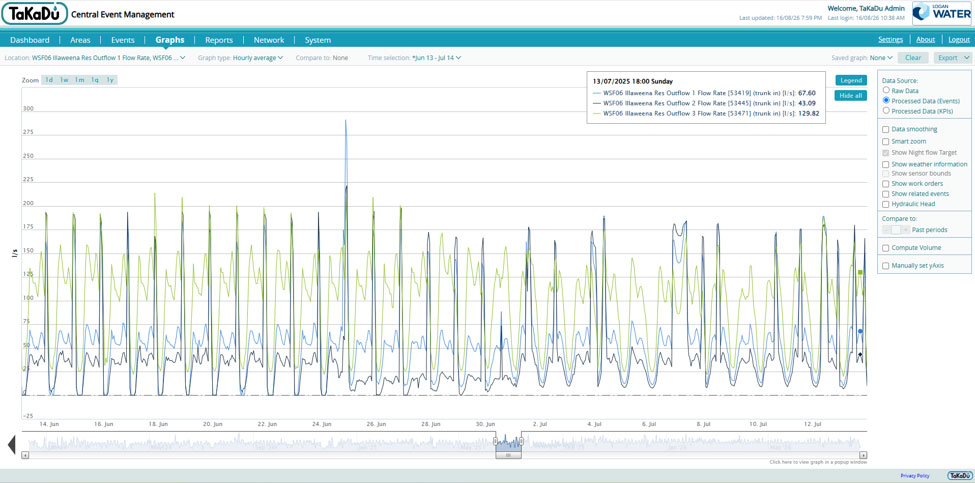
Screenshot 1: TaKaDu Trunk Main Area (TMA 7) Graph – Showing a transmission line or TMA where TaKaDu flags malfunctioning flow sensors that were failing to accurately capture low-flow data.
2. Strategic Pressure Management and PRV Optimization
To guarantee the Desired Standards of Service (DSS), Logan Water is tasked with delivering water at an adequate pressure level to all customers across its footprint. To monitor this standard effectively, Logan installs at least one critical pressure sensor within every DMA and frequently multiple monitoring points in more complex zones.
By feeding this multi-point spatial data into TaKaDu, Logan can track real-time target profiles and detect subtle pressure anomalies or hydraulic deviations the moment they begin, long before they escalate into widespread customer issues or structural damage.
A primary focus of this strategy is the preventative monitoring of Pressure Reducing Valves (PRVs). TaKaDu flags early performance indicators like PRV drift or valve sticking. Keeping these regulating valves working optimally does more than just maintain consistent customer pressure; it directly dampens destructive hydraulic fluctuations, significantly reducing the incident rate of downstream pipe bursts.
Ultimately, this comprehensive level of visibility has enabled Logan to go one step further: safely lowering the overall pressure baseline across the network without breaching their strict DSS thresholds. Because a lower-pressure environment dramatically reduces structural stress on aging assets, Logan has successfully engineered a cycle of fewer network failures, fewer burst incidents, and drastically minimized water loss.
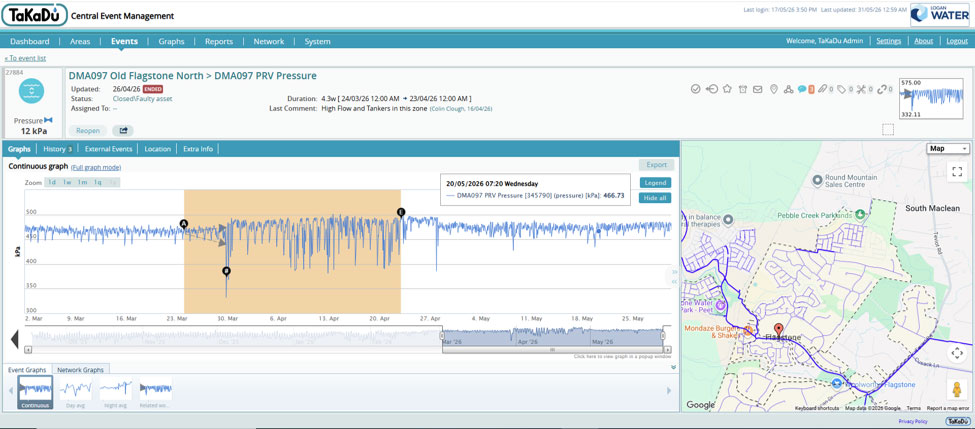
Screenshot 2: Screenshot 2: TaKaDu PRV Failure Event – a flagged PRV drift event.
3. Calming Network Volatility: Eradicating Hydraulic Stress
A cornerstone of Logan Water’s “Calm Network” theme is the mitigation of transient pressure surges often referred to as pressure hammers. These rapid, cyclic pressure spikes place immense structural stress on pipelines, accelerating fatigue and triggering premature bursts.
Using TaKaDu’s Volatile Bounds feature, Logan systematically identifies areas experiencing excessive hydraulic instability. The platform automatically maps out anomalous pressure bands, frequently exposing how standard field operations such as local pumps kicking in can introduce sharp, sudden pressure jumps into the surrounding network. Armed with these specific operational insights, Logan’s teams can adjust pump settings, ramp times, and drive mechanics to smooth out these fluctuations, physically calming the network and dramatically extending infrastructure longevity.
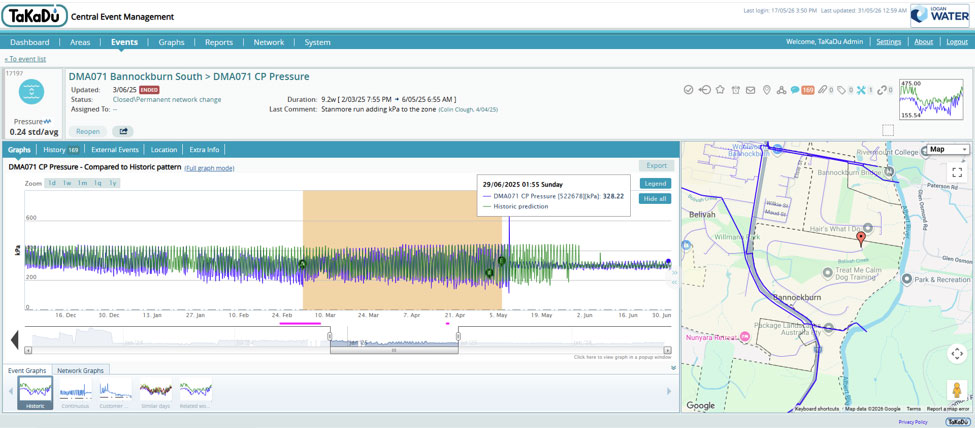
Screenshot 3: TaKaDu Volatile Bounds Event – Showcasing a distinct pattern of high-pressure volatility before stabilization
4. Eliminating Blind Spots via Calculation Events
Maintaining absolute data integrity is a core requirement of operational maturity. In simple District Metered Areas (DMAs) with a single inlet meter, a sensor failure is intuitively obvious: no data means no supply calculation. However, in highly complex zones that feature a structured matrix of multiple incoming and outgoing flow meters, detecting data failure becomes significantly more challenging. If a meter drops out or transmits erroneous values without triggering a standard “no-data” alarm, operators can easily remain unaware that they have lost the capability to calculate the zone’s water balance, creating a dangerous blind spot where a sudden leak could run completely undetected.
To eliminate this risk, Logan Water utilizes TaKaDu’s Calculation Events. This function acts as an automated integrity check, monitoring the mathematical logic between the network structure and the actual data transmitted by the meters. When the system detects an inability to calculate total supply for any reason, a Calculation Event is immediately generated. This gives the utility a rapid window of opportunity to identify the root cause of the data discrepancy, repair the faulty asset, and resume active network monitoring to protect against non-revenue water loss.
A clear example of this capability occurred in DMA 062, a complex zone structured with one incoming flow meter and five outgoing flow meters. When one of the outgoing meters malfunctioned and stopped sending expected values, the system could no longer compute the water balance. TaKaDu immediately issued a calculation event, explicitly highlighting the structural logic failure and pointing operations directly to the specific malfunctioning outgoing meter.
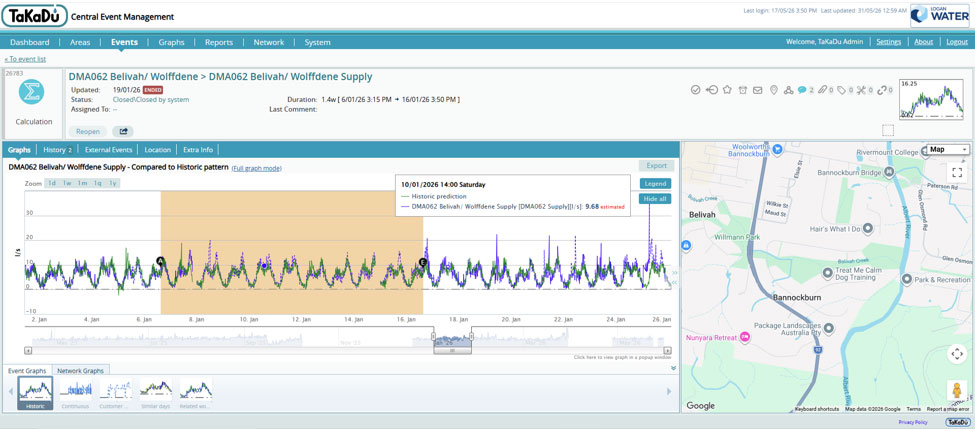
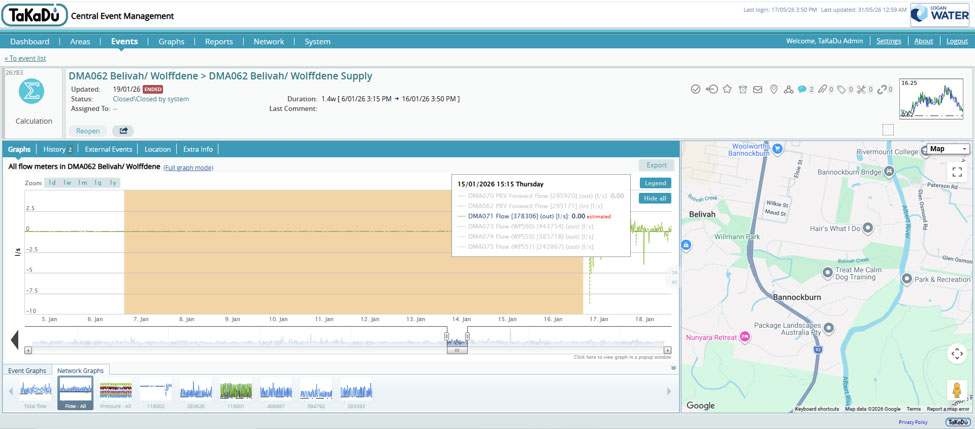
Screenshots 4.1 and 4.2: TaKaDu Calculation Event in DMA 062 – Showing how the system flagged the calculation failure and isolated the underperforming outgoing flow meter # 378306 from the rest of the structure.
Operational Integration and Reporting
As part of their overall plan to measure progress and success, Logan Water established specific management KPIs to track non-revenue water (NRW) strategies and Desired Standards of Service (DSS) pressure compliance. By integrating data from TaKaDu into Power BI via an API, Logan Water can calculate these KPIs as desired. This automated data pipeline allows them to easily generate standardized monthly reports that track network health, leakage reduction trends, pressure baseline performance, and instrumentation upgrades.
Conclusion
By expanding monitoring to upstream trunk mains, managing pressure volatility, and ensuring data integrity through TaKaDu, Logan Water has transitioned to a preventative asset management approach. The integration of this data into Power BI provides management with the clear, structured reporting necessary to track their ongoing success in reducing water loss and protecting network infrastructure.
"We are incredibly proud to partner with Logan Water on their long-term digital transformation journey. Over the years, our relationship has thrived because we actively listen to our customers. By working closely with their engineering teams, we have continually enhanced our software offerings into new operational areas like trunk main monitoring and calculation logic. Seeing Logan leverage these features to mature their solution into sophisticated preventative achievements is exactly why we do what we do."
Udi Geismar, VP Sales & Customer Success, TaKaDu
About Logan Water
Logan Water is a commercialized business unit of Logan City Council, responsible for providing safe, reliable, and sustainable water and sewerage services to a rapidly growing population in Southeast Queensland, Australia. Managing an extensive and evolving network of transmission and distribution infrastructure, Logan Water relies on industry-leading technologies to achieve high operational efficiency, satisfy rigorous state regulatory standards, and consistently deliver adequate standards of service to all residents.
About TaKaDu
TaKaDu is a global pioneer in Central Event Management (CEM) solutions for water utilities. Operating as a cloud-based Software-as-a-Service (SaaS) platform, TaKaDu uses advanced data analytics and machine learning to convert raw telemetry data (flow, pressure, and quality) into real-time, actionable insights. By automatically detecting, classifying, and tracking network anomalies such as leaks, bursts, faulty equipment, and data integrity issues TaKaDu empowers water utilities worldwide to reduce non-revenue water loss, protect assets, and streamline field operations.